A developmental ecosystem
The Puppy Village Model™
Raising confident, capable, well-rounded dogs through collaboration, knowledge, and purpose.
© Charity Knowles | Ruff Ruff Ranch™
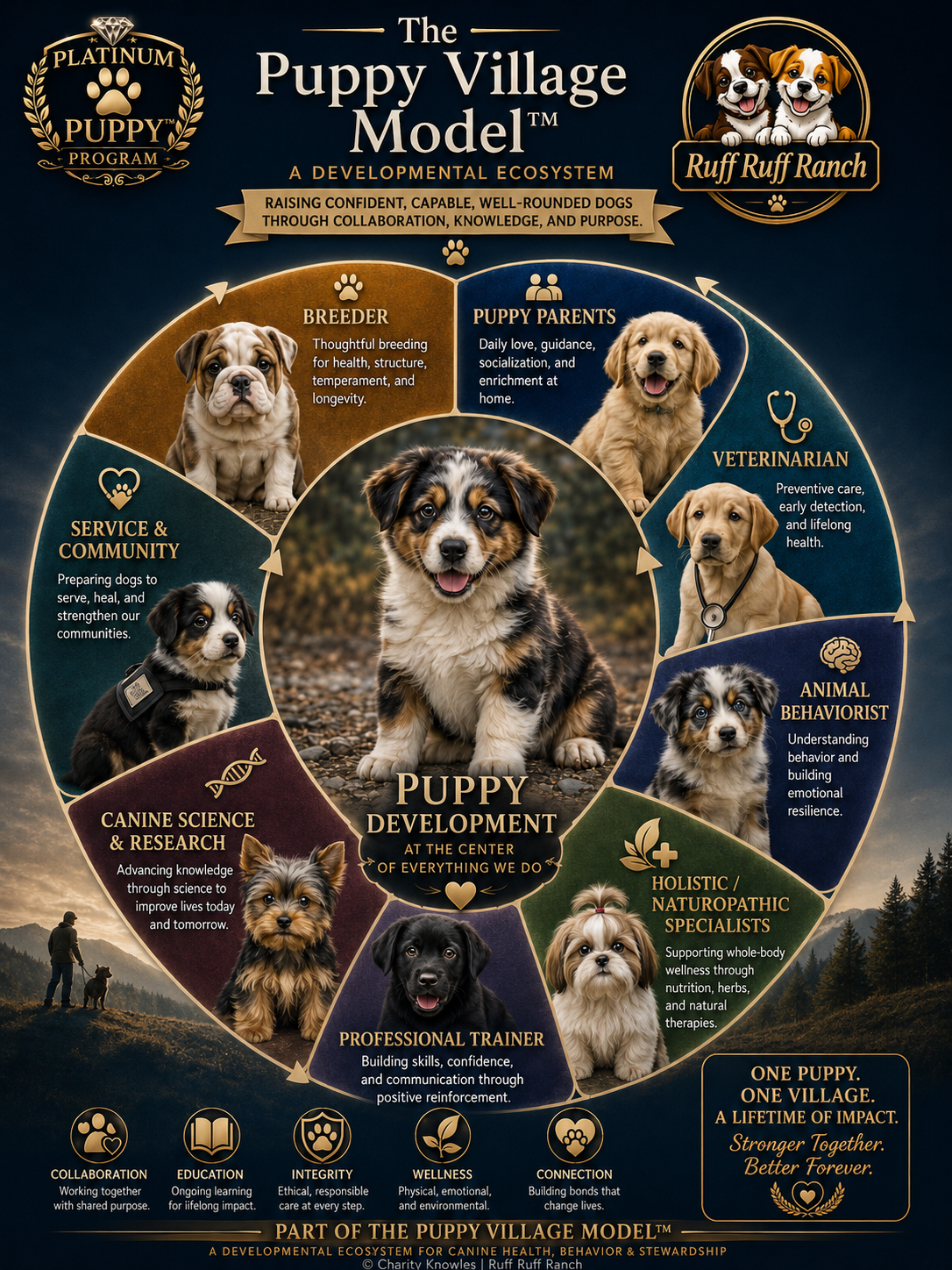
The phrase “it takes a village” is usually offered as encouragement. Here it is meant literally, and structurally. A dog's temperament, health, and behavior are not produced by any single person. They are the cumulative product of every decision made by everyone who touches that dog's life — the breeder who planned the litter, the family who lives with it daily, the veterinarian who catches pain before it becomes reactivity, the trainer who shapes skills, the specialists who support recovery, the research that informs all of it, and the community that keeps the family from raising a puppy in isolation. The Puppy Village Model™ maps that ecosystem so each role can see where it sits and what it owes the others.
The reason to draw it out is practical. When these roles operate as separate silos, families receive contradictory advice from four credible sources in the same week and end up following whichever voice was most confident. Small, solvable issues get missed at exactly the age when they are easiest to change. When the roles are connected, information travels: the breeder's knowledge of the litter reaches the trainer, the veterinarian's findings reach the behavior plan, and the family stops guessing.
The puppy at the center
The puppy sits in the middle for a reason that is easy to say and hard to practise: every role in the ring serves the animal's development, not the adults' preferences, schedules, or ambitions. That means decisions get tested against a single question — does this serve the dog this puppy is becoming? Sometimes the honest answer is to wait. To skip the outing. To postpone the class. To choose a different path than the one the family had imagined. A model with the puppy at the center makes that easier to say out loud.
The breeder: foundations laid before anyone else arrives
The breeder's work begins before conception — health testing, temperament selection, and the physical and emotional environment of the dam during pregnancy. It continues through the neonatal and transitional periods with early neurological handling, graduated novelty, varied surfaces and sounds, protected sleep, and careful weaning. By eight weeks, a great deal about how a puppy handles surprise, frustration, and separation has already been shaped. Ethical breeders also do the least glamorous work in the ring: honest matching of puppies to households, and lifelong willingness to take a dog back.
Puppy parents: the daily architects
Families provide the thing no professional can — thousands of small, ordinary repetitions. Sleep, feeding rhythm, handling, household consistency, exposure decisions, and the emotional tone of daily life. A trainer might see a dog for an hour a week; the family shapes the other hundred and sixty-seven. The Village Model treats families as skilled participants who deserve real education rather than a printed list of rules, because a family that understands the reasoning can adapt correctly to situations no handout anticipated.
The veterinarian: health as the floor under behavior
Behavior sits on top of physiology. Pain, gastrointestinal discomfort, poor sleep, ear infections, joint issues, thyroid function, and nutrition all shape how a dog acts long before anyone calls it a training problem. A meaningful share of dogs presented for behavior concerns have an untreated medical component. The veterinarian is therefore not the emergency contact at the edge of the ring but a routine partner in development, and the model asks families to rule out physical causes early rather than as a last resort.
The animal behaviorist: reading the dog accurately
Where a trainer builds skills, a behavior professional interprets emotion and motivation — what the dog is actually feeling, what is reinforcing a pattern, and whether a response reflects fear, frustration, pain, or learned habit. This role matters most when something is not working, and its greatest contribution is often to correct a misdiagnosis: the “stubborn” dog that is frightened, the “aggressive” dog that is in pain, the “spiteful” dog that is panicking when left alone.
Holistic specialists: recovery, body, and nutrition
Bodywork, structured movement, appropriate nutrition, and genuine recovery support the nervous system that all learning depends on. Within this model, holistic practitioners work alongside veterinary medicine rather than in place of it — supporting resilience, comfort, and physical development while diagnosis and treatment stay in veterinary hands.
The professional trainer: skills, and teaching the humans
The trainer translates development into life skills — recall, settling, loose-leash walking, cooperative care, being alone, public composure — and, just as importantly, coaches the people. Most of a good trainer's value is transferred to the humans: timing, criteria, reading arousal, knowing when to stop. Within Platinum Puppy™, this is where Brain First Training & Games™ lives, along with the specialized eight-to-twelve-week work at Ruff Ruff Ranch™.
Canine science and research: the model updates itself
Everything in the ring is provisional. What we understand about sleep, socialization windows, stress physiology, cognition, and learning has changed substantially in twenty years and will change again. A village that ignores research calcifies into tradition. Including science as a formal role is a commitment to revise practice when the evidence moves — and to be candid with families about what is well supported and what is still opinion.
Service and community: the outer ring that sustains everything
The last segment is the wider community: other families in the same week of the same journey, mentorship, service and therapy pathways for the dogs suited to them, rescue and rehoming support, and public education. This is the part that keeps families going through the low points, and it is why membership in Platinum Puppy Village™ is for the life of the dog rather than the first few months.
Using the model
Read the ring as a checklist for your own dog. Which roles are actually filled? Which are missing? Are the people in them talking to each other, or are you carrying every message between them yourself? Most struggling families are not failing at effort — they are missing a segment, usually the veterinary or the community one. Naming the gap is generally the first step to closing it.
The Puppy Village Model™ is an educational framework. It does not guarantee temperament, behavior, health, service-dog status, therapy-dog approval, ESA qualification, public-access rights, certification, or suitability for any specific role. Concerns involving aggression, severe fear, trauma, medical issues, or safety belong with your veterinarian and a qualified behavior professional.